Monday, February 14, 2022

Cyril and Methodius

Cyril and Methodius, Missionaries, 869, 885

The Collect:

Almighty and everlasting God, who by the power of the Holy Spirit moved your servants Cyril and Methodius to bring the light of the Gospel to a hostile and divided people: Overcome all bitterness and strife among us by the love of Christ, and make us one united family under the banner of the Prince of Peace; who lives and reigns with you and the Holy Spirit, one God, now and for ever. Amen.

Cyril (originally Constantine) and Methodius were brothers, from a noble family in Thessalonika, a district in northeastern Greece. Constantine was the younger, born in about 827, and his brother Methodius in about 825.  They both entered the priesthood. Constantine undertook a mission to the Arabs, and then became a professor of philosophy at the imperial school in Constantinople and librarian at the cathedral of Santa Sophia. Methodius became governor of a district that had been settled by Slavs. Both brothers then retired to monastic life. In about 861, the Emperor Michel III sent them to work with the Khazars northeast of the Black Sea in the Dnieper-Volga region of what was later Russia. They learned the Khazar language and made many converts, and discovered what were believed to be relics of Clement, an early Bishop of Rome.

In about 863, Prince Rotislav, the ruler of Great Moravia (an area including much of what was later Czechoslovakia), asked the emperor for missionaries, specifying that he wanted someone who would teach his people in their own language (he had western missionaries, but they used only Latin). The emperor and the Patriarch Photius sent Methodius and his brother Constantine, who translated the Liturgy and much of the Scriptures into Slavonic.

Since Slavonic had no written form, they invented an alphabet for it, the Glagolitic alphabet, which gave rise to the Cyrillic alphabet (named for Constantine aka Cyril), which is used to write Russian and (with modifications) several related languages today. They used the Greek alphabet as their basis, writing a letter in two forms when two similar sounds in Slavonic each needed a letter (hence, in modern Russian, we have "plain a" written "A" and "fancy a" written like a backward "R" representing the sounds of hard and soft (or unpalatalized and palatalized) a, represented approximately in English by "ah" and "yah"). When no Greek letter was close, then they borrowed from Hebrew (the letter TZADDI for the sound "ts" as in "tsar", and the letter SHIN for the sound "sh", and a variant on it for the sound "shch" as in "Khrushchev", and so on).  The resulting alphabet had 43 letters. It has since undergone development, chiefly simplification and the omission of letters. Thus, the modern Russian alphabet has only 32 letters. The Cyrillic alphabet with minor variations is used today for Russian, Ukrainian, and other languages of the former USSR, and also for Bulgarian and Serbian and formerly for Rumanian.  (Serbs and Croats both speak Serbo-Croatian, but the Serbs, who are traditionally East Orthodox, write it with the Cyrillic alphabet, while the Croats, who are traditionally Roman Catholic, write it with the Latin alphabet. Before the first World War, there were many muslims (regarded as Turks) living in Greece, and many Christians (regarded as Greeks) living in western Turkey. Each group spoke the language of the country in which it lived, but the Greek-speaking Turks in Greece wrote Greek using the Arabic script that was then standard for writing Turkish, and the Turkish-speaking Greeks in Turkey wrote Turkish in the Greek alphabet. For some reason, the alphabet matters to rival religious groups.)

Thus the brothers were the first to produce written material in the Slavic languages, and are regarded as the founders of Slavic literature.

The brothers encountered missionaries from Germany, representing the western or Latin branch of the Church, and more particularly representing the Holy Roman Empire as founded by Charlemagne, and committed to linguistic, and cultural uniformity. They insisted on the use of the Latin liturgy, and they regarded Moravia and the Slavic peoples as their rightful mission field. When friction developed, the brothers, unwilling to be a cause of dissension among Christians, went south toward Venice, and then from Venice to Rome to see the Pope, hoping to reach an agreement that would avoid quarreling between missionaries in the field. They brought with them the above-mentioned relics of Clement, third bishop of Rome after the Apostles (see 23 November). They arrived in Rome in 868 and were received with honor.  Constantine entered a monastery there, taking the name Cyril, by which he is now remembered. However, he died only a few weeks thereafter. He is buried in Rome in the Church of San Clemente.

The Pope (Adrian II) gave Methodius the title of Archbishop of Sirmium (now Sremska Mitrovica in Yugoslavia) and sent him back in 869, with jurisdiction over all of Moravia and Pannonia, and authorization to use the Slavonic Liturgy. Soon, however, Prince Rotislav, who had originally invited the brothers to Moravia, died, and his successor did not support Methodius. In 870 the Frankish king Louis and his bishops deposed Methodius at a synod at Ratisbon, and imprisoned him for a little over two years.  The pope (John VIII) secured his release, but told him not to use the Slavonic Liturgy any more. In 878 he was summoned to Rome on charges of heresy and using Slavonic. This time Pope John was convinced by his arguments and sent him back, cleared of all charges, and with permission to use Slavonic. He died 6 April 885 in Velehrad, the old capitol of Moravia. The Carolingian bishop who succeeded him, Wiching, suppressed the Slavonic Liturgy and forced the followers of Methodius into exile. Many found refuge with King Boris of Bulgaria (852-889), under whom they reorganized a Slavic-speaking Church. Meanwhile, Pope John's successors adopted a Latin-only policy which lasted for centuries.

Today Cyril and Methodius are honored by Eastern and  Western Christians alike, and the importance of their work in preaching and worshiping in the language of the people is recognized on all sides. *

* The Lectionary,  James Kiefer, http://www.satucket.com/lectionary/Cyril&Methodius.htm

Saturday, February 12, 2022

In the Morning


In the Morning - From Psalm 51


Open my lips, O Lord, *

    and my mouth shall proclaim your praise.

Create in me a clean heart, O God, *

    and renew a right spirit within me.

Cast me not away from your presence *

    and take not your Holy Spirit from me.

Give me the joy of your saving help again *

    and sustain me with your bountiful Spirit.

Glory to the Father, and to the Son, and to the Holy Spirit: *

    as it was in the beginning, is now, and will be for ever. Amen.


The Book of Common Prayer, page 137

Friday, February 11, 2022

Sunday, February 13


Sunday, February 13, 2022 - Souper Bowl Sunday

Join us for “at church” or “virtually” for worship this Sunday, February 13, The Sixth Sunday after the Epiphany, at St. Alban’s, St. Thomas’, St. Patrick’s, and Iglesia Episcopal La Esperanza de Familias Unidas. Remember - Masks are optional, and communion will be offered in both kinds- wine by intinction. We strongly urge everyone to get vaccinated. Please maintain social distance in non-family groups.

Holy Eucharist, Rite Two
St. Alban’s - 8:30 a.m. and 10:30 a.m.*
St. Thomas' - 10:00 a.m.*
St. Patrick’s – 11:00 a.m.*

* These liturgies will be Live-Streamed on Facebook for those who choose to remain at home. Download a pdf of the leaflet to print or to use on your phone or tablet with this link - https://drive.google.com/file/d/1NZShBTG6fe7q4_5wnRCFvPebAO2JyUI_/view?usp=sharing                


La Santa Eucaristía: Rito Dos en la iglesia (primer y tercer domingo del mes y transmitido en vivo en Facebook) o Oración de la tarde diaria a través de Zoom (los otros domingos del mes)

Iglesia Episcopal La Esperanza de Familias Unidas – Domingo - 5:00 p.m.


Oración Vespertina Diaria a través de Zoom - Únete aqui
https://us02web.zoom.us/j/89906444437?pwd=bmdXYW9kNjVicVJHU3Fkb3BrMitKZz09
ID de reunión: 899 0644 4437
Contraseña: 500
o llame al +1 312 626 6799 or  +1 346 248 7799


Zoom Compline - All Welcome 

Sunday -  8:00 p.m. WILL NOT BE READ - Enjoy the Super Bowl AND make a donation to the Souper Bowl at https://tacklehunger.org/ or in the Souper Bowl Pot at Church!


We hope to “see” you all on Sunday as you are most comfortable!

Rita+, Rob+ and Whit+

Art from Clip Art, Steve Erspamer, Liturgy Training Publications – ltp.org

A Souper Bowl long ago!

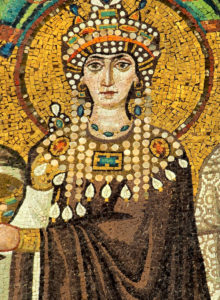
Theodora

Theodora, Empress, c.867

The Collect:

O God, who called your servant Theodora to an earthly throne that she might advance your heavenly kingdom and who gave her the wisdom to establish unity where there had been division; Create in your church such godly union and concord that we might proclaim the Gospel of the Prince of Peace, not only in correct theology but in right actions. All this we ask through the same Jesus Christ our Lord, who lives and reigns with you and the Holy Spirit, one God, for ever and ever. Amen.

Theodora (c. 815 – after 867) was a Byzantine Empress as the spouse of the Byzantine emperor Theophilos, and regent of her son, Michael III, from Theophilos' death in 842 to 855. She is best known for her restoration of the veneration of icons, which ended the Byzantine Iconoclasm.

Originally from Paphlagonia (on the Black Sea coast of what is now Turkey), Theodora was of Armenian aristocratic descent.

In 829, Theophilos succeeded to the throne. He was sixteen-years-old and unmarried. The following year, in May, 830, Theodora was chosen to become empress, probably by her new mother-in-law. The marriage took place on 5 June 830, in Hagia Sophia.

Despite the fact that Theophilus was an iconoclast, Theodora held fast to the veneration of icons which she kept in her chambers in the imperial palace. Theophilus' health eventually failed and he died on 20 January 842. He was about twenty-nine years old.

Following the death of her husband, Theodora served as regent for her son Michael. She overrode Theophilus' ecclesiastical policy and summoned a council under the patriarch Methodius, in which the veneration, but not worship, of icons was finally restored and the iconoclastic clergy deposed. *

* The Lectionary, via Wikipedia, http://satucket.com/lectionary/Theodora.html

Thursday, February 10, 2022

It's Souper Bowl Time!

Souper Bowl - Souper Bowl of Caring


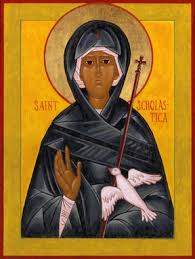
Scholastica

Scholastica of Nursia, Monastic, 543

The Collect:

Assist us, O God, to love one another as sisters and brothers, and to balance discipline with love and rules with compassion, according to the example shown by your servant Scholastica; for the sake of your Son Jesus Christ our Lord, to whom with you and the Holy Spirit be all honor and glory, now and for ever. Amen.

Scholastica (c. 480 – 10 February 543) is a saint of the Roman Catholic Church and the Eastern Orthodox Churches. She is the foundress of the women's branch of Benedictine Monasticism.

According to the Dialogues of Gregory the Great, Scholastica was born c. 480 in Nursia, Umbria, of wealthy parents. While Gregory states that Scholastica was Benedict's sister, a later tradition, says she was his twin. Whether this is meant biologically or allegorically (spiritually) or both is not clear. Gregory the Great says she was dedicated to God from a young age. She and her brother Benedict were brought up together until the time he left to pursue studies in Rome.

Benedictine tradition holds that Scholastica established a hermitage about five miles from Monte Cassino and that this was the first "Benedictine" convent.

The most commonly told story about her is that she would, once a year, go and visit her brother at a place near his abbey, and they would spend the day worshiping together and discussing sacred texts and issues.

One day they had supper and continued their conversation. When Benedict indicated it was time for him to leave, perhaps sensing the time of her death was drawing near, Scholastica asked him to stay with her for the evening so they could continue their discussions. Not wishing to break his own Rule, Benedict refused, insisting that he needed to return to his cell. At that point, Scholastica closed her hands in prayer, and after a moment, a wild storm started outside of the guest house in which they were housed. Benedict asked, "What have you done?", to which she replied, "I asked you and you would not listen; so I asked my God and he did listen. So now go off, if you can, leave me and return to your monastery." Benedict was unable to return to his monastery, and they spent the night in discussion.

Three days later, from his cell, he saw his sister's soul leaving the earth and ascending to heaven in the form of a shining white dove. Benedict had her body brought to his monastery, where he caused it to be laid in the tomb which he had prepared for himself. *

* The Lectionary, via Wikipedia, http://www.satucket.com/lectionary/scholastica.html

Wednesday, February 9, 2022

Valentine


Saint Valentine, 
Priest and Martyr, circa 269 C.E.

Because St. Valentine is not officially on the Episcopal Church’s Calendar or that of the Roman Catholic Church, and as a “public service” announcement, and reminder for forgetful lovers that Valentine’s Day is next Monday - Today, we will learn a bit more about the uncertain history of this 3rd century martyr.

Join us today, Wednesday, February 9 at 12:10 p.m. for Holy Eucharist at the church, or tonight on Zoom for Evening Prayer and our Video Study Class.

Zoom Evening Prayer & Video Study Class

Wednesday, 5:30 p.m.

Join Zoom Meeting
https://us02web.zoom.us/j/86781577595?pwd=VjNnZTZnUFFadkJPc3VOVTh3K21Idz09
Meeting ID: 867 8157 7595
Passcode: 530
Dial by your location +1 312 626 6799 or +1 346 248 779

More information about St. Valentine from Encyclopedia Britannica Online follows:

St. Valentine, (died 3rd century, Rome; feast day February 14), name of one or two legendary Christian martyrs whose lives seem to be historically based. Although the Roman Catholic Church continues to recognize St. Valentine as a saint of the church, he was removed from the General Roman Calendar in 1969 because of the lack of reliable information about him. He is the patron saint of lovers, epileptics, and beekeepers.

By some accounts, St. Valentine was a Roman Catholic priest and physician who suffered martyrdom during the persecution of Christians by the emperor Claudius II Gothicus about 270. He was buried on the Via Flaminia, and Pope Julius I reportedly built a basilica over his grave. Other narratives identify him as the bishop of Terni, Italy, who was martyred, apparently also in Rome, and whose relics were later taken to Terni. It is possible these are different versions of the same original account and refer to only one person.

According to legend, St. Valentine signed a letter “from your Valentine” to his jailer’s daughter, whom he had befriended and healed from blindness. Another common legend states that he defied the emperor’s orders and secretly married couples to spare the husbands from war. *

* Britannica, The Editors of Encyclopedia. "St. Valentine". Encyclopedia Britannica, 5 Jan. 2021, https://www.britannica.com/biography/Saint-Valentine